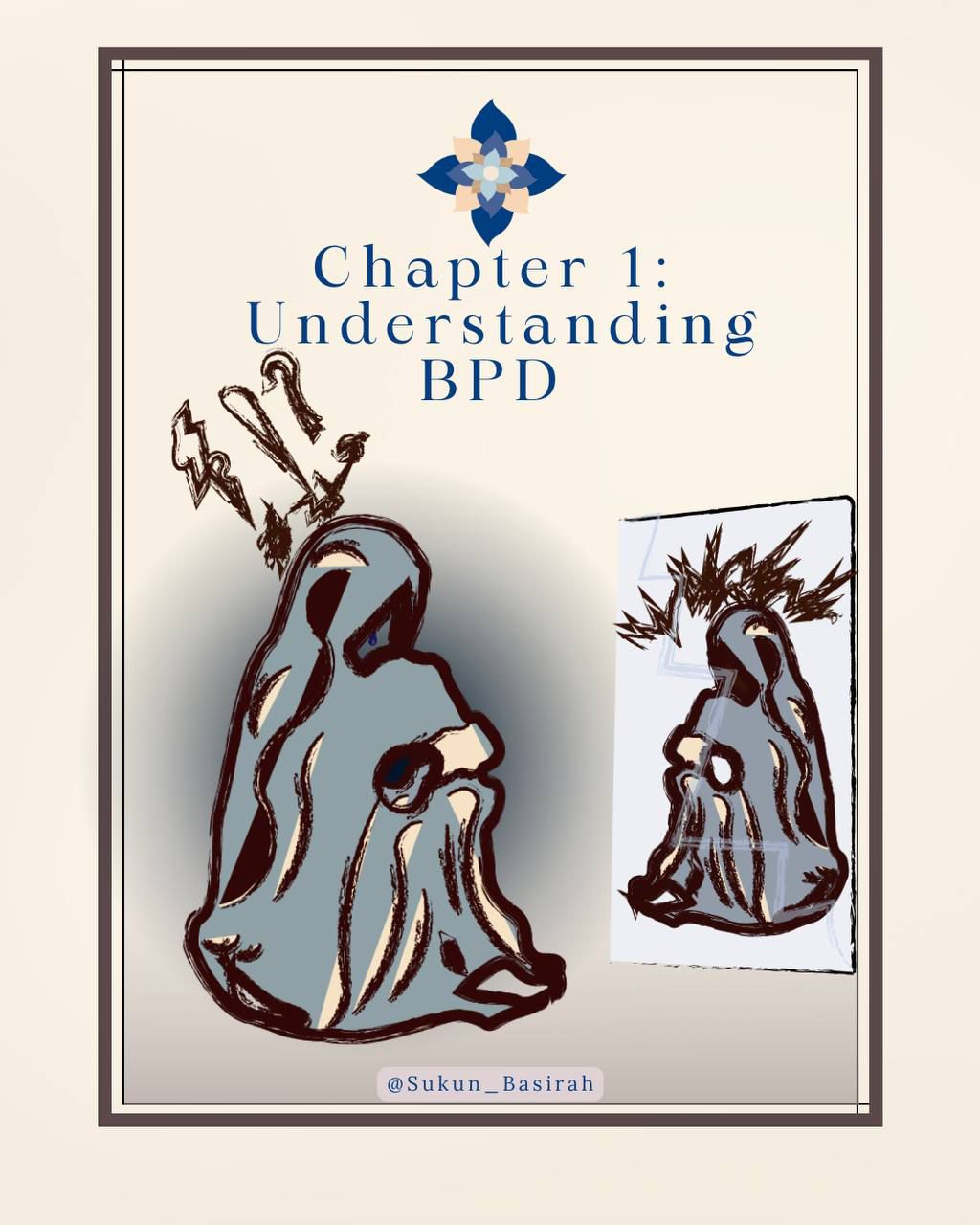
What BPD Actually Is
Borderline Personality Disorder, often shortened to BPD, is a mental health condition that affects how a person feels emotions, sees herself, relates to others, and responds to emotional pain. It is real. It is recognised by every major medical body in the world. And it is treatable, alhamdulillah.
The official medical guide used by doctors — the Diagnostic and Statistical Manual of Mental Disorders, 5th edition (DSM-5) — describes BPD as a pattern of intense and unstable emotions, a fragile sense of self, difficulty in close relationships, and strong impulsive responses. Researchers often group these struggles into three main areas: emotional dysregulation (feelings that come on quickly and intensely), interpersonal hypersensitivity (a deep ache around closeness and rejection), and impulsivity (acting on emotion before thought).
The Inner World Behind the Symptoms
What people sometimes label as "drama" or "weakness" is, in reality, a deeply sensitive inner world. Studies in Frontiers in Psychiatry and World Psychiatry describe how people with BPD often feel emotions more intensely, more quickly, and for longer than others — a quality sometimes called emotional sensitivity. A small reaction in someone else might feel like a wave the size of a house to a sister with BPD.
This is not chosen. Brain imaging studies have shown structural and functional differences in regions of the brain that handle emotion and impulse control. This is not a moral failing. It is a way of being that came together over time.
Who Lives With This?
BPD is estimated to affect somewhere between 1.4% and 5.9% of adults at some point in their lives. In clinical settings (hospitals, therapy clinics), the rate is much higher — around 10% of psychiatric outpatients and 15–20% of inpatients. Historically, around 75% of those diagnosed have been women, though newer studies suggest the actual gap between men and women may be smaller — women may simply be diagnosed more often. Men with BPD are sometimes misdiagnosed with PTSD or depression instead.
The Most Important Thing to Know
BPD has one of the most hopeful long-term outcomes of any serious mental health condition. A 16-year follow-up study from McLean Hospital, called the McLean Study of Adult Development, found that around 50% of patients reached recovery (meaning they no longer met the criteria for BPD and had a meaningful relationship and were working or studying), and 93% achieved symptom remission lasting at least two years.
Read that again. This is not a life sentence.
A Soft Reminder
If anything in this reflection feels familiar, please know: you are not too much. You are not broken. You are a sister whose heart was shaped by a thousand small things you may never fully name. With the right support — a qualified therapist, gentle community, and the mercy of Allah — your inner world can soften, your relationships can heal, and your peace can return, bidhnillah.
Sources & Further Reading
- American Psychiatric Association. Diagnostic and Statistical Manual of Mental Disorders (5th ed., Text Revision). 2022.
- Chapman J, Jamil RT, Fleisher C. Borderline Personality Disorder. In: StatPearls [Internet]. National Center for Biotechnology Information, 2024.
- Leichsenring F, et al. "Borderline personality disorder: a comprehensive review of diagnosis and clinical presentation, etiology, treatment, and current controversies." World Psychiatry, 2024.
- Biskin RS, Paris J. "Diagnosing borderline personality disorder." CMAJ, 184(16):1789–1794, 2012.
- National Institute of Mental Health (NIMH). Personality Disorders — Statistics.
- Sansone RA, Sansone LA. "Gender patterns in borderline personality disorder." Innovations in Clinical Neuroscience, 8(5):16–20, 2011.
- Bozzatello P, et al. "Gender differences in borderline personality disorder: a narrative review." Frontiers in Psychiatry, 2024.
- Zanarini MC, et al. "Attainment and stability of sustained symptomatic remission and recovery among patients with borderline personality disorder: a 16-year prospective follow-up study." American Journal of Psychiatry, 169(5):476–483, 2012.