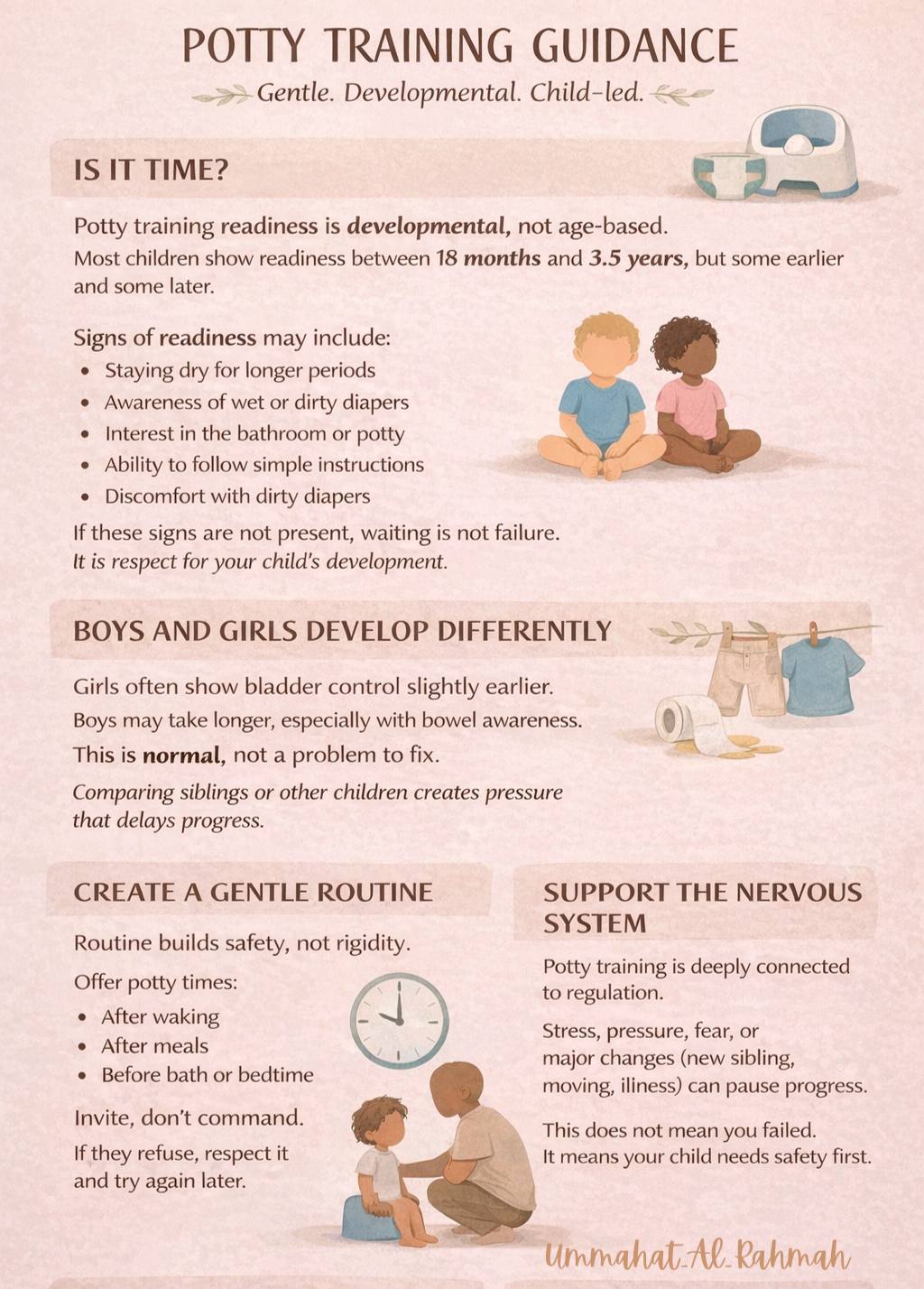
Potty training is often treated like a milestone that can be rushed with enough charts, reminders, routines, or pressure. But toileting is not simply a behavior to “teach.” It is a developmental process that depends on the body, the brain, the bladder and bowel, emotional readiness, and a child’s growing sense of control over their own body. Readiness signs matter more than age alone, and starting before those systems are working together can make the process harder, not easier.
This is why some children seem to “get it” quickly, while others need much more time. It is also why waiting is not failure. In many cases, waiting is what protects the process from becoming a power struggle.
Readiness Is Developmental, Not Age-Based
There is no single correct age for potty training. Children commonly begin showing readiness signs sometime between 18 months and 3 years, but the timeline varies widely. The best guide is not a birthday, but whether the child can notice the urge, connect the feeling to the potty or toilet, and cooperate with the process.
A child may be more ready when they can stay dry for longer stretches, notice when they are peeing or pooing, show discomfort with a wet or soiled nappy, sit down and stand up independently, follow simple instructions, communicate the need to go, and pull clothes up and down with help or growing independence. These are not random signs. They reflect nervous system maturity, bladder and bowel signaling, body awareness, motor coordination, and emotional readiness beginning to align.
If those systems are not yet working together, potty training can easily turn into resistance, accidents, withholding, and stress. That does not mean the child is difficult. It means the timing may not be right yet.
Some Children Start Earlier, Some Much Later
Many children begin somewhere in the toddler years, and many are dry in the daytime by around age four. Nighttime dryness often takes longer, and bedwetting in younger children is still considered a normal developmental pattern. A child who is not ready “on time” is not necessarily behind. A slower pace can still be completely normal.
Boys and Girls May Follow Different Timelines
Children do not all develop toileting skills at the same pace. On average, boys often complete toilet training later than girls, though individual variation matters more than group averages. This does not mean boys are lazy, behind, or less capable. It simply means children do not mature in identical ways, and comparison is rarely helpful.
Comparing siblings, cousins, or children at nursery often increases pressure on the parent, and children can feel that pressure very quickly.
Potty Training Is Nervous System Work
To toilet successfully, a child needs more than knowledge. They need to sense internal signals, pause what they are doing, get to the potty or toilet, sit in a secure position, and relax enough to release. If the child is frightened, pressured, ashamed, or overstimulated, the body may resist rather than cooperate. Pediatric and continence guidance advises against punishment, scolding, or turning toileting into a battle, because pressure can create fear, withholding, constipation, and more accidents.
A child cannot easily relax their pelvic floor when they feel anxious, rushed, watched too closely, afraid of getting it wrong, afraid of disappointing a parent, or embarrassed by accidents. In other words, potty training is not just about the potty. It is about whether the child feels safe enough in their body to let go.
Daytime and Nighttime Are Not the Same
One of the most important things parents are rarely told is that daytime training and nighttime dryness are not the same process. Nighttime dryness is strongly developmental, and bedwetting is normal in many younger children. Nighttime control often comes later than daytime control. Some children do not yet make enough nighttime antidiuretic hormone, which helps the body reduce urine production during sleep. That is one reason nighttime dryness cannot simply be “trained” in the same way daytime toilet use can.
Night nappies are not a moral failure. Bedwetting is not laziness. Regularly waking a child to pee does not help long-term dryness. Patience matters more than pressure. The body matures when it matures.
What Actually Helps
Evidence-based potty training support is usually much less dramatic than social media makes it seem. The most helpful ingredients are often simple: a calm and neutral response to accidents, praise for effort without pressure, easy clothing, a secure potty or toilet setup, support under the feet, noticing natural rhythms without over-controlling them, and pausing during major stress or transition.
Foot support matters more than many parents realize. Continence guidance recommends a stool or secure foot support when using the toilet because having the feet supported helps a child feel safe and relax enough to empty the bladder and bowel more fully.
Helpful language can sound like this: “Your body is still learning.” “That’s okay, we’ll try again next time.” “Accidents happen.” “You’re learning what your body feels like.” This kind of language protects trust and keeps the process from turning into shame.
Modeling Without Oversharing
Children often learn through observation and imitation. That does not mean parents need to show anything private. It can simply mean letting the child see the routine around toileting in a modest, practical way: walking to the bathroom, sitting on the potty, flushing, washing hands, and following the same sequence each time. Siblings can also model those habits naturally.
The point is familiarity. The more ordinary and unthreatening the process feels, the easier it is for many children to engage with it.
Commonly Overlooked Reasons Potty Training Gets Stuck
When progress stalls, parents often blame themselves first. But some of the most important blockers are physical or situational.
Constipation is one of the biggest and most overlooked reasons potty training becomes difficult. Even mild constipation can affect bladder function, lead to accidents, make bowel movements painful, and trigger withholding. A child who has had one painful poo may begin holding it in. That withholding can make the stool harder, which makes the next bowel movement hurt more, creating a cycle that can derail toileting completely.
Fear can also block progress. Some children are frightened by the size of the toilet, the flushing sound, or the feeling of falling in. Unsupported posture can make things worse. If a child is dangling on a toilet seat without foot support, it is harder to feel secure and harder to relax the muscles needed to empty properly.
Major life changes can also delay readiness or cause setbacks. A new baby, weaning, illness, travel, moving house, nursery changes, disrupted sleep, or family stress can all affect toileting. Too much reminding can also backfire. Some reminders are helpful, but constant hovering can shift the process away from the child’s body awareness and into parent control.
Common Mistakes Parents Make Without Realizing
Many parents are trying their best and still end up doing things that make the process harder, usually because they were told it would help. Common mistakes include starting mainly because of age or pressure from others, comparing one child to another, reacting emotionally to accidents, using rewards in a way that creates pressure, forcing sitting when a child is clearly resistant, trying to push through during stress or transition, and expecting nighttime dryness too early. Pediatric guidance advises avoiding treats and punishments as the main engine of potty training, because mastery itself is the goal and heavy reward systems can distract from it.
Regression Is Often a Stress Signal, Not a Failure
One of the hardest parts of potty training is the moment it seems to be working, and then suddenly it isn’t. A few dry days. A few successes. Some relief. Then accidents start again. Refusal returns. Your child avoids the potty, cries, hides, or acts as if they have forgotten everything.
This can be deeply discouraging, but setbacks are common. Potty training is not always linear. A pause or regression does not necessarily mean the child has lost the skill. Sometimes it means the child’s system is overwhelmed, stressed, distracted, constipated, or simply not ready to hold the skill consistently yet. What looks like “back at zero” may actually be the body saying, “This feels like too much right now.”
Why Stepping Back Can Help
Sometimes the most supportive thing a parent can do is step back. That does not mean giving up. It means reducing pressure, returning to neutral language, allowing accidents without frustration-loaded commentary, pausing if needed, and trying again later.
When a child feels supported rather than judged, they are more likely to return to the process with confidence. Children do not lose skills by being supported. Very often, they regain them with more confidence and less stress.
The Role of Autonomy
Toileting is one of the earliest areas where a child experiences bodily autonomy in a very direct way. Adults can invite, guide, support, prepare, and encourage, but they cannot force the body to release on command without consequences.
When children feel safe, respected, unhurried, included, and increasingly in control, their bodies often cooperate more easily. When they feel watched, shamed, overmanaged, pressured, or powerless, their bodies may resist.
This is part of why potty training can become a power struggle so quickly. It sits right at the meeting point of development, control, privacy, and trust.
When to Get Extra Help
Most potty training challenges are normal and resolve with time, but there are times when it makes sense to speak with a pediatrician or child health professional. That includes pain with peeing or pooing, ongoing constipation, blood in the stool, frequent urinary accidents after prior dryness, signs of a urinary tract infection, significant fear or distress around toileting, daytime wetting that persists beyond age expectations, or bedwetting in an older child with other symptoms.
A Final Reminder
Potty training is not a test of your worth as a parent. It is not proof that your child is advanced. It is not a measure of obedience, intelligence, or your parenting skill.
There is no prize for being early. There is no shame in being later. There is no failure in waiting.
Success is not a toddler who performs on schedule for other people. Success is a child who feels safe in their body, learns to notice its signals, and reaches this milestone in a way that protects trust rather than fear.
And that unfolds on its own timeline.