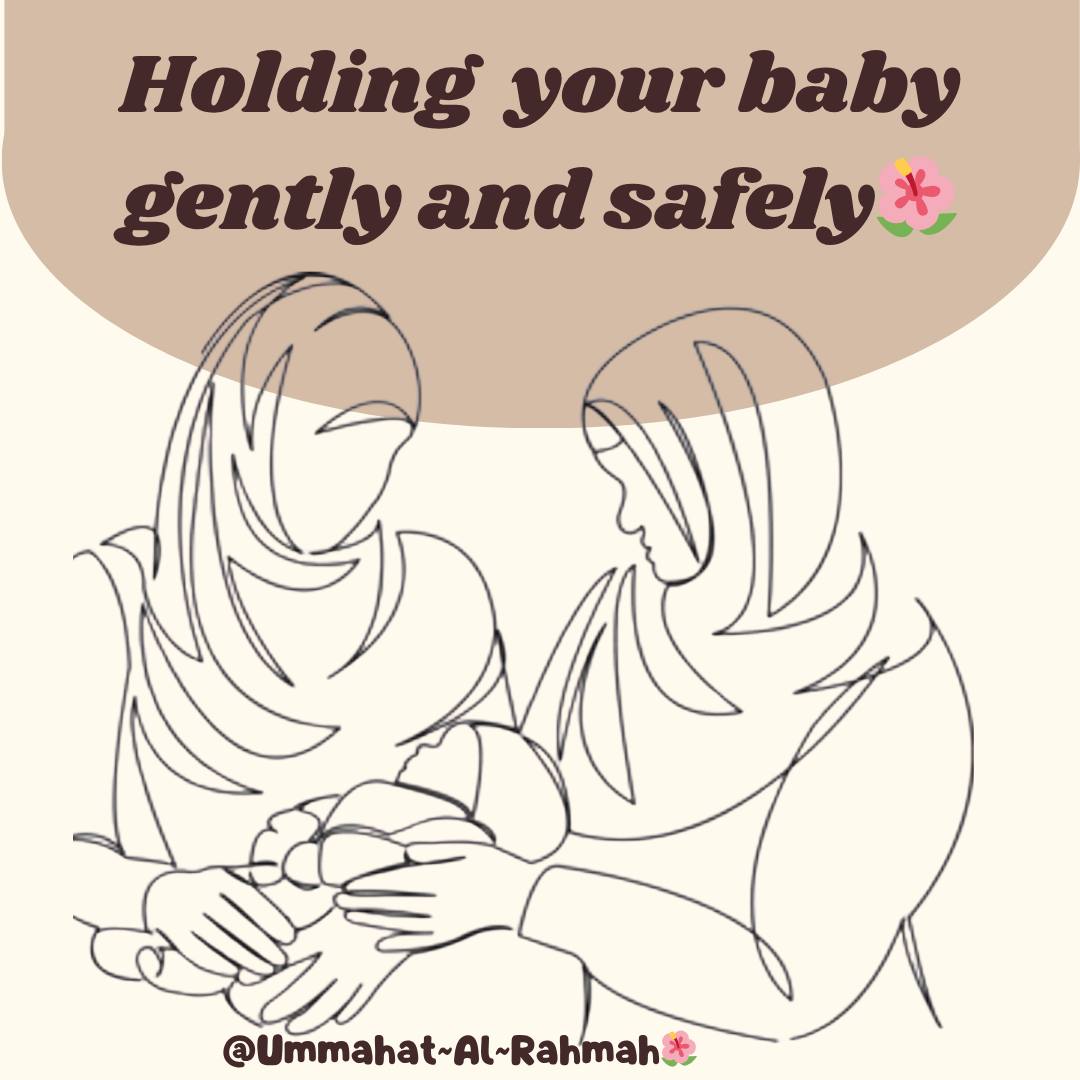
We hold our babies countless times a day. We hold them to feed, soothe, rock, comfort, burp, settle, and simply enjoy being close to them. Most of the time, we do what feels natural, and Alhamdulillah that is often enough. But because we hold them so often, even small adjustments in how we support their bodies can make a real difference over time.
This is not about creating fear or making mothers feel that there is only one perfect way to hold a baby. It is simply about becoming more aware of how a baby’s body is developing, what kind of support they need at different stages, and how to carry them in a way that feels safe, gentle, and comfortable for both baby and parent.
Why Support Matters in the Early Months
In the early months, babies are still developing head control, trunk strength, and postural stability. Newborns especially need their head and neck supported because they cannot yet hold them steady on their own. Health guidance for slings and carriers also stresses that until babies can support their own heads, they should be carried in a way that keeps the head and airway safe, the face visible, and the back well supported.
A baby’s hips also matter here. Hip-health guidance recommends positions that allow the hips to stay bent and comfortably apart, often called the “M” position or spread-squat position, because this supports healthy hip development while the hips are still growing rapidly.
So when we talk about holding a baby “the right way,” what we really mean is supporting the head, neck, back, and hips in a way that works with their body rather than against it.
Common Mistakes Many Parents Make Without Realizing
Many of us were never actually taught how to hold a baby properly. We just copied what we saw around us. That is very normal. But some common habits can make a baby less comfortable or less supported than they could be.
One example is lifting a young baby under the arms before they have enough head and trunk control. Another is carrying a baby upright for long periods without enough support through the back and neck. Some parents also end up carrying their baby on the same side all the time, which can be tiring for the parent’s own body and can make holding less balanced overall.
Another thing to watch is letting the legs hang straight down for long periods when the baby is in your arms or in a carrier. Hip-health guidance favors bent, supported legs rather than letting the lower body dangle without support.
None of this means you are doing something terrible. It simply means that once you know what to look for, small changes can make carrying more supportive and more comfortable, in sha’ Allah.
How to Hold a Newborn
For a newborn, the goal is closeness and full support. Hold your baby against your chest with one hand supporting the head and neck and the other supporting the bottom and back. Their body should feel gathered and secure, not loose or unsupported. Because newborns still need a lot of help with posture, they should not be left in a position where the head flops backward or sideways without support. Guidance for carriers similarly emphasizes that the baby should be close enough to kiss, in view at all times, with the chin off the chest and the back supported.
This close, tucked-in style of holding usually feels best for very young babies because it mimics the secure, curled closeness they are used to.
Holding Babies as They Grow
As babies get a little older and begin developing stronger neck control, they can enjoy being held more upright. But upright does not mean unsupported. Even when a baby seems stronger, they still benefit from support through the trunk and a position that keeps their body close to yours rather than hanging away from you.
By the middle months, many babies also begin showing more interest in looking around, pushing against you, twisting, and changing position in your arms. This is normal and part of development. As they gain strength, they are learning how to balance, turn, and organize their body in space. The American Academy of Pediatrics notes that babies around four to seven months are learning to balance themselves more and gradually building the skills that support sitting.
So as your baby grows, the support changes, but the principle stays the same: close, secure, and responsive to what their body can handle.
The “M” Position and Why It Helps
One of the most helpful things to know is the hip-healthy “M” position. This means the baby’s knees are bent and usually a little higher than the bottom, with the thighs supported. The International Hip Dysplasia Institute describes this as a healthy position for the hips because it allows the hips to spread naturally and keeps them in a more supportive posture.
This does not mean you need to obsess over angles every time you pick up your baby. It simply means that bent, supported legs are generally better than long periods of dangling or overly straight positioning, especially in the younger months.
Watching Your Baby’s Cues
One of the best guides is your baby’s own body language. Are they settled and relaxed in your arms? Are they constantly arching away? Do they seem floppy, tense, or calm? Does their head feel supported? Are their hips and legs comfortably positioned?
Babies often tell us a lot through how they respond. A small adjustment in your hold can sometimes make a big difference in how secure they feel.
The Clingy Days
Some days your baby simply wants to be held all day. They cry when you put them down, settle only against your chest, and seem to need more closeness than usual. That is normal. It does not mean you have spoiled them or created a bad habit. Babies seek closeness for many reasons, including comfort, regulation, tiredness, growth spurts, overstimulation, and needing reassurance.
On those days, it helps to make carrying easier on your own body too. Before lifting your baby, it can help to ground your feet, relax your shoulders, and bring them in close to your center rather than carrying them away from your body. The closer they are to your chest or side, the easier it usually is on your arms and back.
It also helps to switch sides often, especially if you notice yourself always using the same hip or arm.
Traditional Back Carrying and Babywearing
Some babies love standard carriers. Others do not. Some prefer to be on the back rather than the front. Some settle better in cultural or traditional wrapping methods that keep them close and secure. That preference is real, and it is okay to work with what helps your baby feel calm, as long as it is safe.
When using a sling or carrier, safety matters just as much as comfort. UK safer-sleep and sling guidance recommends the TICKS principles: the sling should be tight, your baby should be in view at all times, close enough to kiss, with their chin off their chest and their back supported. Younger babies especially need a secure upright position where the face stays visible and breathing is not blocked.
Hip-health guidance also recommends carriers that support the thighs and allow the hips to rest in the “M” position rather than hanging straight down. At the same time, the International Hip Dysplasia Institute also notes that based on the best available evidence, no baby carrier by itself is proven to cause or prevent hip dysplasia, so the goal is supportive positioning, not fear.
A Very Important Safety Note About Sleep in Carriers and Swings
If your baby falls asleep in a carrier, sling, swing, stroller, or car seat, they should be moved to a firm, flat, non-inclined sleep surface as soon as practical. The American Academy of Pediatrics says these products are not a substitute for a safe sleep space.
That matters because many babies do drift off while being carried or rocked. The carrying itself can be beautiful and helpful, but sleep safety still needs to be protected.
Using Swings Carefully
Swings can be useful at times, especially when a parent needs a short break or a place to settle a fussy baby for a little while. But they are best seen as a short-term tool, not a place where a baby should spend long stretches of time or sleep unattended.
If you use a swing, make sure your baby is correctly secured according to the manufacturer’s instructions, that the head and body are well supported, and that the baby is supervised. Swings are for brief use, not a replacement for carrying, floor time, or a safe sleep space. The AAP says babies who fall asleep in swings should be moved to a firm, flat sleep surface as soon as possible.
Supporting Both Baby and Mother
Safe holding is not only about the baby. It is also about you. If you are always holding your baby in a way that strains your back, shoulder, wrist, or hip, that matters too. The best hold is one that supports your baby well and is sustainable for your own body.
This is why changing sides, bringing baby close to your center, and using supportive carriers correctly can be so helpful. Good positioning should feel secure, not like you are constantly fighting your own posture.
What This Is Really About
Holding and carrying your baby is one of the sweetest, most frequent parts of early motherhood. It is not about following one rigid method or becoming anxious over every movement. It is about awareness.
It is about noticing that your baby needs different support at different ages. It is about protecting their head and neck when they are small. It is about keeping their hips comfortably supported rather than letting them dangle for long periods. It is about using carriers and slings in a way that keeps them close, visible, supported, and safe. And it is about making small changes that help both of you feel more comfortable.
There is not one perfect way to hold your baby. But there are gentler, more supportive ways. And often, those small adjustments are enough.